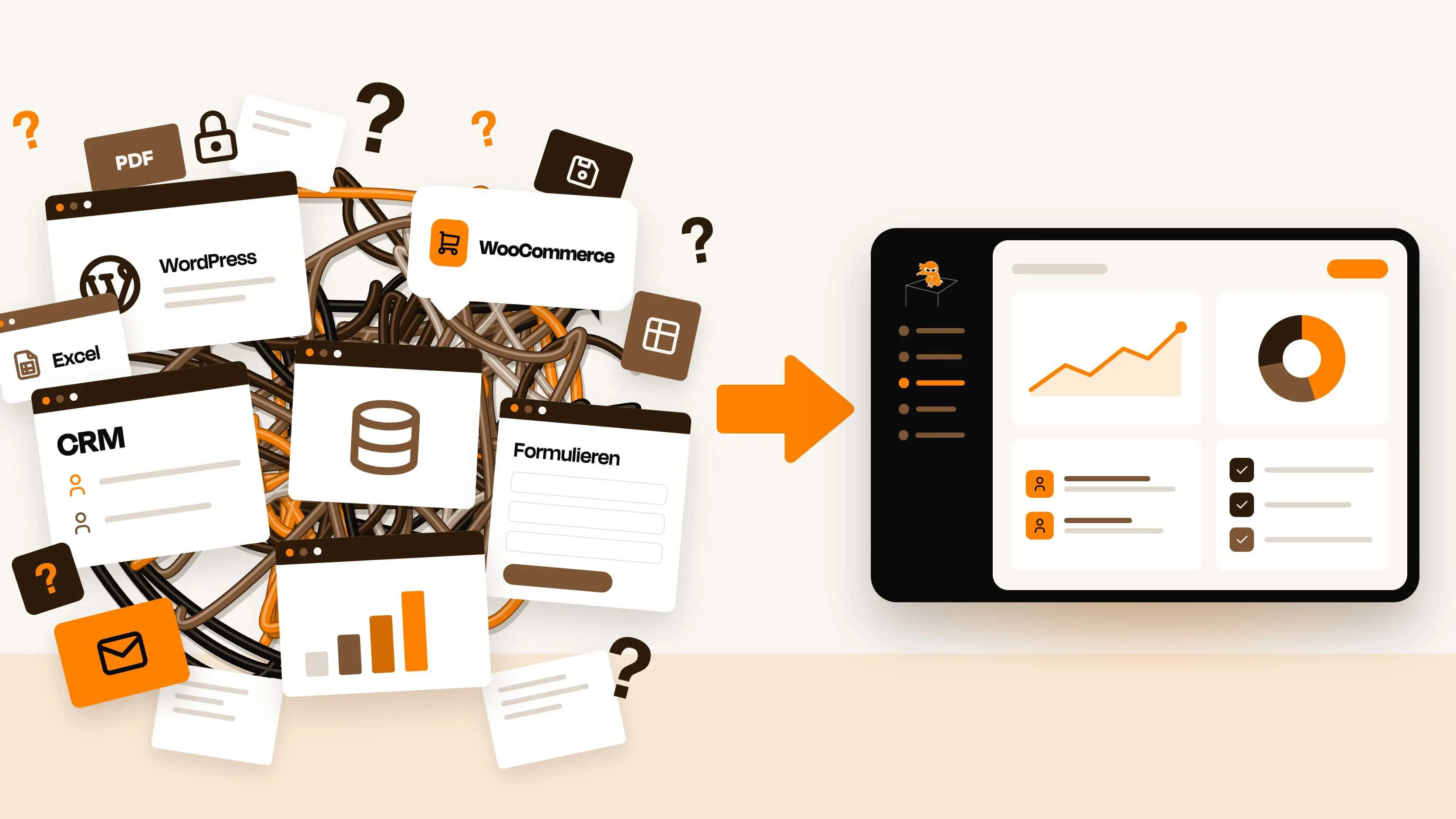
Not every organization needs the same type of website. For one, a compact website with a clear range of services is enough. For another, the website has to communicate with a CRM, ERP, booking system or other applications and forms the heart of a complete digital ecosystem.
But which types of websites are there? And more importantly: which type of website fits your organization?
In this article we distinguish five common types: a portfolio website, content website, service website, e-commerce website and digital platform. These types can overlap. A web shop can, for example, also contain a lot of knowledge content and a service website can be part of a larger digital platform.
More functionality is not automatically better, either. The right website supports what users want to achieve and what the organization needs.
1. Portfolio website: a strong digital foundation
Suitable for: freelance professionals, creative agencies, consultants and smaller organizations.
A portfolio website is a relatively compact website that is mainly intended to show who you are, what you do and why someone should choose you.
Think of:
- an overview of services;
- projects or cases;
- an about-us page;
- customer references;
- a clear way to get in touch.
For photographers, designers, architects and other creative professionals, visual work often plays the leading role. For consultants and business service providers, expertise, cases and a clear range of services are usually more important. An example of this is the website for Woedend Creative Agency.
A good portfolio website doesn't have to be technically complicated. Speed, ease of use, accessibility and a convincing presentation are more important. The international Web Content Accessibility Guidelines 2.2 from W3C provide guidelines for making websites perceivable, operable, understandable and robust for different users.
When does a portfolio website suit you?
A portfolio website is a good choice when your website mainly serves as a digital business card and lead generator. Visitors don't have to perform complicated actions. They must quickly understand what you offer, be able to view proof of your expertise and easily get in touch.
This type of website fits less well when you want to publish a lot of content structurally, offer complex services online or need to connect various business systems.
2. Content website: building expertise and being found
Suitable for: service providers, B2B organizations, startups, knowledge organizations and companies that want to reach new customers structurally through their website.
A content website goes a step further. Besides the most important company information, the website contains extensive content on topics that potential customers, members or other target groups search for.
Think of:
- articles and knowledge bases;
- cases and projects;
- extensive service or product pages;
- research and whitepapers;
- frequently asked questions;
- news and events;
- guides and other practical information.
This structure makes it possible to answer different questions from potential customers on separate pages. That helps users and search engines find and understand the information.
According to Google's SEO Starter Guide search engine optimization is about, among other things, helping search engines understand your content and helping users decide whether they want to visit your website.
Good findability isn't about publishing as many pages as possible. Google advises creating reliable, people-first content that actually adds value.
A clear website structure helps search engines and users understand:
- what your organization has expertise in;
- which services or products you offer;
- for which target groups they are relevant;
- how different topics relate to each other.
When does a content website suit you?
Choose a content website when organic findability, knowledge sharing and lead generation are important parts of your marketing strategy.
For many B2B organizations this is a strong foundation. The website is then not only a place where visitors find information, but also a platform with which the organization structurally builds expertise and digital authority.
A good CMS is important here. Content staff must be able to publish articles, cases and pages without depending on a developer for every change.
3. Service website: visitors can arrange something directly
Suitable for: organizations where visitors make appointments online, place reservations, request information, submit documents or perform other actions.
On a service website, a visitor doesn't just view information, but also performs a task. The website thereby becomes part of the service delivery.
For this, the website can be connected to other software. Via APIs, different systems can exchange data with each other and make functionality available. MDN Web Docs describes APIs as interfaces with which developers can use complex functionality from other systems.
On a service website, think for example of:
- a booking system with current availability;
- registrations for classes or courses;
- online reservations;
- forms that forward data to a CRM;
- personal customer information;
- calculators and other interactive tools;
- integrations with marketing automation;
- AI features or chatbots.
A dental practice can, for example, show available appointments from its own scheduling system on the website. A training provider can let visitors view trainings and sign up directly.
For Stichting Amsterdam Hip Hop Centre Ninjible developed, for example, an integration with the class booking system, so that visitors can view and book available classes.
When does a service website suit you?
This type of website becomes interesting as soon as employees or customers regularly perform actions that can be made simpler or partly automated.
The website then changes from a communication channel into a digital service environment. That can improve the user experience while reducing manual work within the organization.
During development, careful thought must be given to data quality, security, privacy and error handling. What happens, for example, when a connected system is temporarily unavailable? And which system is leading when data contradict each other?
4. E-commerce website: selling products or services online
Suitable for: retailers, brands, manufacturers and other organizations that sell directly through their website.
On an e-commerce website, online sales are central. Visitors must be able to easily find, compare and check out products.
A web shop therefore consists of much more than a number of product pages and a shopping cart. Depending on the organization, integrations are needed with, among other things:
- inventory management;
- payment providers;
- order management;
- CRM;
- PIM, i.e. Product Information Management;
- fulfillment and logistics;
- marketing and email systems;
- customer service and returns processes.
For relatively simple web shops, platforms such as Shopify and WooCommerce can offer a good solution. As product ranges, countries, processes or integrations become more complex, the need for technical setup and possibly custom development also increases.
Ease of use is essential in e-commerce. The Checkout UX research by Baymard Institute from 2025 shows that the majority of the large web shops studied still offer a mediocre or poor checkout experience. Even at established web shops, many improvements therefore remain possible.
When does an e-commerce website suit you?
An e-commerce website suits organizations where the whole or part of the customer journey takes place online: from orientation and product selection to payment, delivery and after-sales service.
Among other things, speed, trust, product information, search functionality, filters and a simple checkout are important. Every unnecessary step between product and purchase can cause extra friction.
5. Digital platform: the website as part of an ecosystem
Suitable for: larger organizations, retailers, B2B service providers, logistics organizations and companies with complex digital processes.
With this type of solution, the website is no longer just a standalone communication channel. It becomes a digital platform that connects various systems, data sources, users and processes.
Think, for example, of an automotive platform on which visitors can:
- compare models;
- configure a car;
- view current stock;
- find a dealer;
- book a test drive;
- request a quote;
- later manage their request or order.
Behind one user experience, dozens of systems and data sources can work together. The same applies to retailers with click-and-collect, logistics organizations with track-and-trace or B2B platforms on which customers configure products, request quotes, manage orders and receive service.
The platform must then communicate with, for example, CRM, ERP, PIM, logistics and financial systems.
Why is a digital platform more complex?
The challenge often doesn't lie in one specific functionality, but in the cooperation between all the parts. Data must be exchanged reliably and securely. Existing systems are not always made to communicate with each other in real time.
Sometimes good APIs are available. In other situations middleware is needed to connect systems and data flows. It may also be necessary to modernize a legacy system first.
UX, software architecture, security, data management and integrations must therefore be considered together from the start. In such a situation we prefer to speak of a digital ecosystem rather than just a website.
The five types of websites can overlap
The five types of websites are not hard categories and also don't automatically form a fixed growth order. An organization doesn't have to have a portfolio website first before it can develop a web shop or service website.
In practice, different characteristics are often combined:
- a portfolio website can get an extensive knowledge base;
- a content website can let people book appointments;
- a web shop can be part of a larger digital ecosystem;
- a service website can contain personal customer environments;
- a digital platform can combine content, services and e-commerce.
Bigger or more complex is not automatically better. The right website is the website that fits the target audience, business objectives, processes and the existing IT landscape.
How do you choose the right type of website?
A good website project doesn't start with the question:
“Which functionalities do we want to build?”
Start with questions such as:
- Who needs to use the website?
- What is that user trying to achieve?
- Which business objectives must the website support?
- What information must the website offer?
- Which processes can be smarter or simpler?
- Which existing systems must the website work with?
- Who must be able to manage the website after delivery?
- Which requirements apply for accessibility, privacy and security?
- How must the website be able to grow in the coming years?
Only after that do you determine which technology, architecture and functionalities are needed. AI can speed up that development process considerably these days, but human expertise remains important when building a professional website.
A website that is findable in Google and AI
The way people discover websites is changing too. Potential customers use traditional search engines, but also increasingly ask extensive questions in AI-driven search environments.
That doesn't mean traditional SEO is disappearing. In its official explanation of AI features and websites Google states that the existing SEO foundation also remains relevant for visibility in AI Overviews and AI Mode. According to Google, no separate technical requirements or special optimizations are needed to appear there as a supporting link.
A technically sound website, clear information architecture, relevant content, internal links and good crawlability therefore remain important. Content must also make clear who you are, what you do, who you do it for and why you are a reliable source.
Concrete examples, cases, expert authorship, current information and a clear content structure help users and search engines understand your organization better. Google advises investing in unique, reliable and helpful information, rather than in isolated 'GEO hacks'.
Which type of website does your organization need?
That ultimately doesn't depend on how many pages you want, but on what your organization and users need to be able to do with the website.
For some organizations a fast, clear content website is exactly enough. For other organizations the biggest gain lies precisely in connecting systems, automating processes or developing a complete digital platform.
Ninjible helps organizations put that digital puzzle together. From strategy and UX to product design, engineering, AI and automation. Curious which type of website or digital platform fits your organization? Get in touch and discuss the possibilities with our experts.