
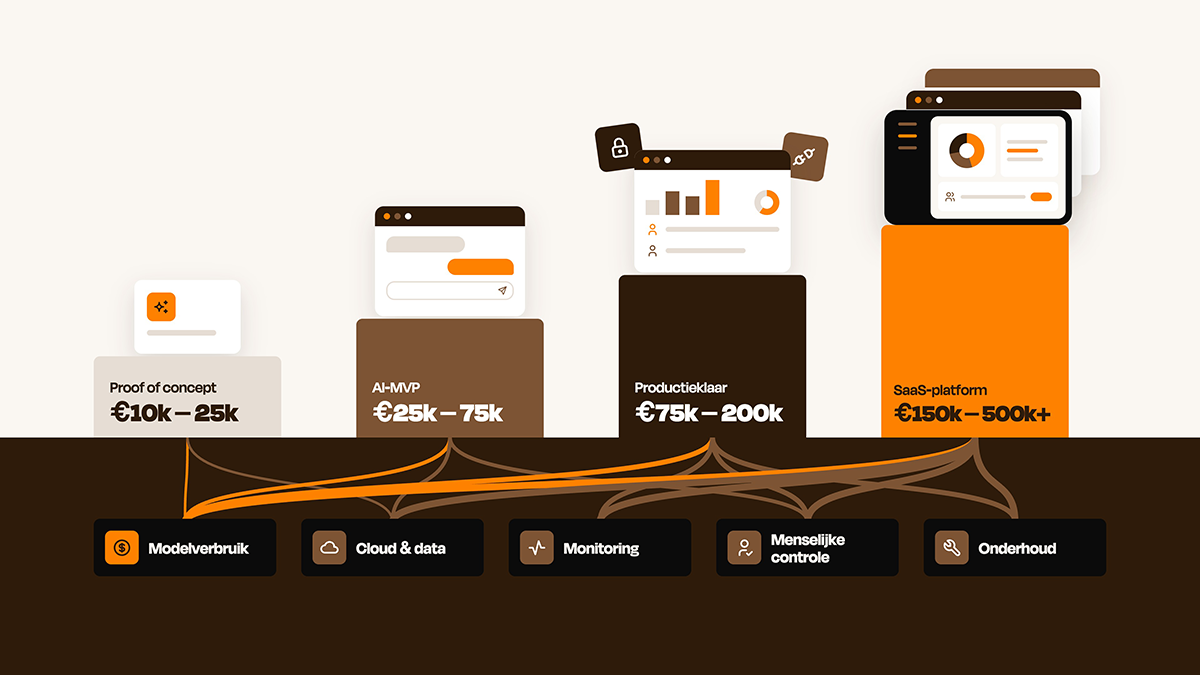
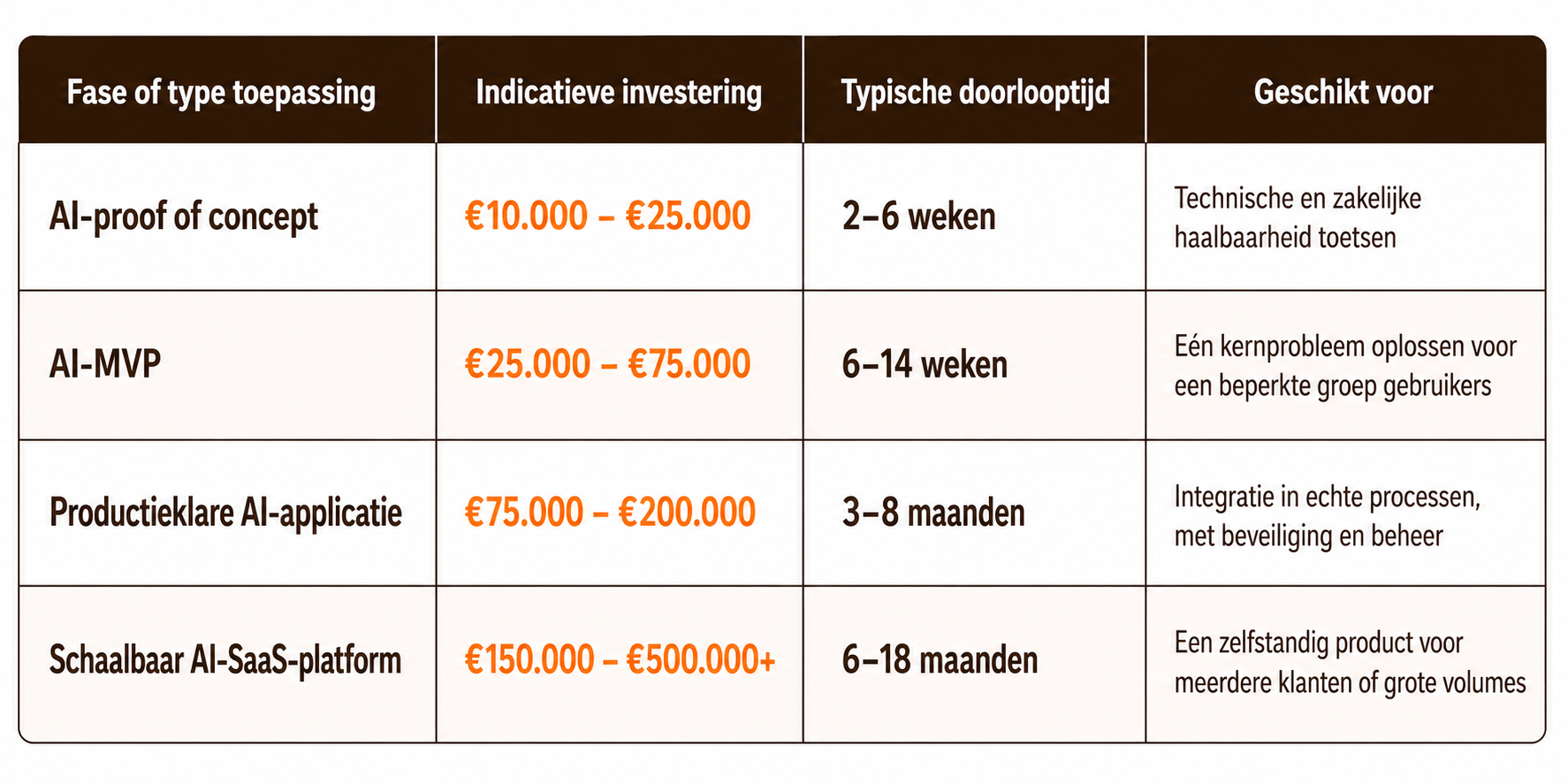
Short answer: a well-scoped AI proof of concept usually starts around €10,000 to €25,000. For a usable AI MVP, a realistic investment is often between €25,000 and €75,000. A production-ready AI application with integrations, security and maintenance rather costs €75,000 to €200,000. If you build a scalable SaaS platform with multiple user roles, subscriptions and intensive AI usage, the investment can rise to €150,000 to €500,000 or more.
These are indicative prices, not standard packages. The real costs are determined by what the application has to do, which data is available, how many systems need to be connected and how often the AI is used. That last factor in particular is often underestimated: after the build, costs for models, cloud infrastructure, monitoring, maintenance and human oversight keep running.
Costs of an AI application at a glance
These ranges are intended as an initial budgeting framework. Searchlab also names a broad market range of €5,000 to €500,000+ for AI implementations, depending on the type of solution. A quote can only be accurate once the use case, users, data sources, desired reliability and expected volumes are clear.
Why the question 'what does AI cost?' is too simple
An AI chatbot that draws answers from twenty well-maintained documents is something different from a platform that analyzes thousands of cases, performs actions in external systems and has different access rights per customer. Both are quickly called an 'AI application', but technically and financially they are hardly comparable.
The price difference usually isn't just in the AI model. It lies mainly in everything needed to make that model a reliable part of a real process:
- strategy and validation of the use case;
- UX and product design;
- preparation and unlocking of data;
- integrations with existing software;
- application development and cloud infrastructure;
- privacy, security and access management;
- testing, evaluation and human oversight;
- monitoring, maintenance and further development.
That also explains why an impressive demo can be relatively cheap, while a reliable production version demands much more. A demo only has to show that something is possible. A production environment must demonstrably work securely, stably, explainably and scalably, even with exceptions and misuse. That is exactly where the difference lies between quickly generating something and professionally engineering software with AI.
What do you get for €10,000 to €25,000? A proof of concept
A proof of concept (PoC) answers one question: can this AI application work both technically and commercially?
Think of an internal assistant that retrieves information from a limited set of documents, a prototype that classifies emails or a model that supports a single manual check task. The interface is often simple, the number of integrations limited and the solution is not yet rolled out widely.
A good PoC contains not only working technology, but also success criteria agreed in advance. For example:
- at least 90% correct classifications in a representative test set;
- 30% less manual handling time;
- an answer within five seconds;
- at most a certain amount in model costs per executed task.
Without such criteria, an experiment quickly becomes a technology demo without a decision moment. That risk is real. RAND describes, based on interviews with 65 experienced data scientists and engineers, that according to some estimates more than 80% of AI projects fail. One of the main causes: organizations build for the wrong problem or use measures that don't match the real workflow.
What does an AI MVP cost?
For an AI MVP, €25,000 to €75,000 is a usable first indication. A minimum viable product is not a throwaway demo, but the smallest version with which real users can experience value and with which you can validate assumptions.
An AI MVP usually contains:
- one sharp core functionality;
- a usable interface;
- one or a few data sources or integrations;
- basic security and user management;
- logging and feedback options;
- measurements for quality, usage and costs.
The smartest saving in this phase is rarely 'choosing a cheaper model'. Much more gain comes from keeping the scope small. Build, for example, first an AI assistant that gives an employee a substantiated draft recommendation, instead of an autonomous agent that carries out the complete process. That way you test the value with less risk and have real usage data sooner.
From MVP to production-ready AI application
The step from a validated MVP to an application used daily in an organization often brings the investment to €75,000 to €200,000. Requirements are added here that didn't weigh heavily during an experiment:
- integrations with CRM, ERP, CMS or case management systems;
- single sign-on and detailed permissions;
- processing of personal data or confidential information;
- quality checks, audit logs and version control;
- fallback scenarios when the model fails;
- dashboards for usage, performance and costs;
- support, uptime and incident management.
This is also the phase in which organizational change becomes important. According to McKinsey's 2025 global AI research 88% of surveyed organizations use AI in at least one business function, but only about a third have started scaling. Organizations that do realize a lot of value more often redesign complete workflows and clearly define when human validation is needed.
Implementing the technology without adapting the work process is therefore usually an expensive way of automating an unchanged process. The business case gets stronger when you simultaneously determine who makes which decision, which exceptions require human attention and how feedback flows back into the system. That directly touches on digital culture: technology only delivers value when people and processes move along.
What does a scalable AI SaaS platform cost?
An AI feature in an internal application is not yet a SaaS product. For a scalable AI SaaS platform, €150,000 to €500,000+ is a more realistic starting point. The exact investment depends strongly on the number of customer organizations, users, data volumes, countries and compliance requirements.
Besides the AI feature, you then also build a commercial software product with, for example:
- multiple customer environments (multi-tenancy);
- roles, permissions and admin portals;
- onboarding and self-service;
- subscriptions, invoicing and usage limits;
- scalable cloud architecture;
- extensive monitoring and support;
- APIs and integrations;
- model routing and cost allocation per customer;
- security and compliance processes.
With SaaS, the cost price must also fit the revenue model. If a customer pays €99 per month but causes €80 in model and cloud usage, hardly any room remains for support, development and margin. Unit economics, i.e. the revenue and variable costs per customer or task, therefore belong in the MVP already.
The seven factors that determine the price most
1. The complexity of the task
Summarizing text is more predictable than preparing legal advice, analyzing images or independently performing multiple actions. The greater the consequences of an error, the more validation, security and human oversight are needed.
2. The quality and accessibility of data
AI doesn't automatically get good from a lot of data. Documents can be outdated, duplicated, contradictory or poorly structured. Cleaning, labeling, anonymizing and making data accessible often takes more time than expected beforehand.
For applications where users have to search through large amounts of information, semantic search and AI-driven search technology can be part of the solution, for example.
3. The number of integrations
A standalone tool is cheaper than an application that has to securely read and write in various business systems. Legacy systems, limited APIs and complicated permission structures increase the effort.
4. The desired reliability
A creative brainstorming tool may occasionally surprise. An application supporting financial, medical or legal processes may not. Higher reliability requires test sets, evaluations, source references, guardrails and review by experts.
5. The usage volume
More users and longer documents mean more model usage, storage and compute. Agents in particular can cost a lot: they don't execute a single prompt, but plan, use tools, check results and retry steps.
The Financial Times reported in 2026 that Uber, Walmart and Cisco, among others, capped AI usage after costs rose sharply. According to the newspaper, Uber set a monthly limit of $1,500 per user. Also, Frankwatching describes how token usage, vector databases, monitoring and agents make the bill add up.
6. Model choice and vendor dependency
Not every task needs the most powerful model. A good architecture can send simple tasks to a small, cheap model and only pass complex tasks on to a heavier model. That lowers costs and limits dependence on a single vendor.
MT/Sprout shows that open and Chinese models are sometimes considerably cheaper than the heaviest American models, but rightly warns that self-hosting isn't free: hardware, energy, management and specialist knowledge remain necessary. The cheapest token price is therefore not automatically the lowest total cost.
7. Legislation, privacy and security
Working with personal data, intellectual property or sensitive business information requires appropriate storage, processor agreements, access management and risk assessment. Depending on the application, obligations from the European AI Act may also apply. Adding compliance afterwards is almost always more expensive than including privacy and security by design.
The hidden costs after launch
Anyone who looks only at the build price underestimates the total cost of ownership. After going live, take into account:
- Model usage: costs per token, image, audio minute or executed task.
- Cloud and data: hosting, databases, storage, backups and data traffic.
- Monitoring: watching quality, speed, errors, misuse and costs.
- Human oversight: assessing exceptions and approving high-risk outcomes.
- Maintenance: APIs, models and connected systems change constantly.
- Evaluation: periodically testing that performance doesn't deteriorate.
- Support and adoption: guiding users and continuing to improve the process.
As a first rule of thumb, reserve 15% to 25% of the initial development investment annually for technical management, maintenance and further development. Model and cloud usage usually come on top of that and must be budgeted separately based on volumes. For an intensively used AI product, the variable costs can ultimately weigh more heavily than the maintenance budget.
How to calculate the business case of AI
The relevant question is not only what the application costs, but what one successful task delivers. Therefore make a simple calculation before the build:
Annual value = time savings + extra revenue + avoided errors and risks
Annual costs = depreciation of build costs + management + human oversight + model and cloud usage
Suppose a process occurs 4,000 times per month. AI saves an average of six minutes per task and an hour fully loaded costs €50. Then the potential time value is €20,000 per month. Subtract implementation, oversight, licenses and usage from that. Moreover, don't calculate with 100% adoption or error-free automation, but make a conservative, a realistic and an ambitious scenario.
After going live, measure at least:
- cost per completed task;
- time saved per user or process;
- percentage of outcomes that need human correction;
- error rate and impact of errors;
- adoption and repeat use;
- extra revenue, conversion or customer satisfaction where relevant.
That prevents 'many prompts' or 'many active users' from wrongly being seen as return. The FD notes that AI costs for companies rise quickly while the return is often still unclear. More usage is only positive if it demonstrably delivers more value than cost.
How do you keep the costs of AI manageable?
- Start with one valuable process. Choose a recurring problem with sufficient volume, available data and a measurable outcome.
- Validate before you scale up. Test technical feasibility, usage and business value with a PoC or MVP.
- Design for cost per task. Determine early what one summary, analysis or agent run may cost at most.
- Don't use the heaviest model by default. Route tasks based on required quality, speed, privacy and price.
- Limit context and repetition. Send only relevant data, cache reusable results and prevent endless agent loops.
- Set budgets and alerts. Monitor usage per customer, team, function and model.
- Avoid vendor lock-in. Where possible, build an abstraction layer so that models or hosting can be changed later.
- Keep comparing with human value. Automating makes no sense when checking and repairing ultimately cost more than the original work.
When is custom development smarter than an existing AI tool?
An existing SaaS tool is usually the best choice if the process is generic and the software largely does what you need. You can start faster and the upfront investment is low.
Custom development becomes more interesting when:
- the workflow is distinctive for your organization;
- multiple data sources or systems have to work together;
- you need control over data, UX, quality or costs;
- standard software leaves a lot of manual work in place;
- the AI functionality itself becomes part of your product or revenue model;
- large volumes make custom development more economical in the long run.
Sometimes a hybrid solution is best: use existing models and infrastructure, but build the interface, workflow, integrations and quality controls custom. That way you invest in what is distinctive without having to train a fundamental AI model yourself.
Frequently asked questions about the cost of an AI application
What does it cost to have an AI application built?
An AI proof of concept costs indicatively €10,000 to €25,000, a usable MVP €25,000 to €75,000 and a production-ready custom application €75,000 to €200,000. A scalable AI SaaS platform often starts around €150,000 and can exceed €500,000. Complexity, data, integrations, reliability and usage volume determine the final price.
What does AI cost per month after launch?
That varies from a few hundred euros for a limited application to tens of thousands of euros or more with large volumes and autonomous agents. The monthly costs consist of model usage, cloud infrastructure, monitoring, maintenance, support and human oversight. Budget usage per task and work with limits and alerts.
Is an AI MVP cheaper than traditional software?
Not automatically. With existing AI models, functionality can be built faster, but AI requires extra work for data, evaluation, monitoring and error handling. A small, sharp MVP is often cheaper than directly building a full platform, mainly because you avoid investing in unproven features.
Do you have to train your own model for an AI application?
Usually not. Many business applications can use existing models, supplemented with your own documents, instructions and integrations. Training or fine-tuning a model only becomes interesting when the task is very specific, sufficient high-quality training data is available and the extra performance justifies the investment.
How do you prevent unexpectedly high AI costs?
Measure the costs per user and task, set hard budget limits, limit the amount of context sent along and use smaller models for simple tasks. Don't let agents repeat steps indefinitely and design the architecture so that you can switch between models.
Prove value first, then scale up
A good AI application doesn't start with the question of which model you want to use, but with the process that must demonstrably get better. With a sharp use case, measurable success criteria and insight into the cost per task, you can start small without thinking small.
Ninjible helps organizations from discovery and AI MVP to a secure, scalable application or SaaS platform. We map out not only the build costs, but also data, integrations, risks, usage and the revenue model. See how Ninjible develops digital products and AI solutions. That way, before the investment you know which value you want to prove and which costs grow along with success.
Do you want to know what your AI application realistically costs? Schedule an intake.