The illusion of 'done quickly'
Vibe coding works fantastically for a quick prototype or proof of concept. The AI generates hundreds of lines of code within minutes. It works, the screen shows green and the stakeholder is enthusiastic. Also when building a website with AI the big win is the speed with which you can go from idea to working prototype.

But there is a crucial difference between an application that runs and one that can scale, is secure and can be maintained professionally. When you ask a Large Language Model (LLM) to add functionality without a tight architecture, something treacherous often happens: the AI can hallucinate, glues together libraries that don't belong together and generates spaghetti code.
The three big vibe coding risks for businesses
Anyone who uses vibe coding for production environments (live and online applications) sooner or later faces three hard realities:
1. Unmanageable technical debt
AI models look at the immediate task, not at the bigger picture. They solve a problem at a local level, but often ignore reusability and maintainability. After five iterations, neither the user nor the AI understands how the code really works under the hood. As soon as something breaks, the entire application often has to be rebuilt from scratch.
2. Security and privacy as an afterthought
An LLM is trained on patterns, not on your specific security compliance. The result? Unsecured API endpoints, hardcoded credentials, vulnerable dependencies (dependencies) and possible data leaks. With vibe coding, critical human oversight of security-by-design is missing.
3. Uncontrollable costs
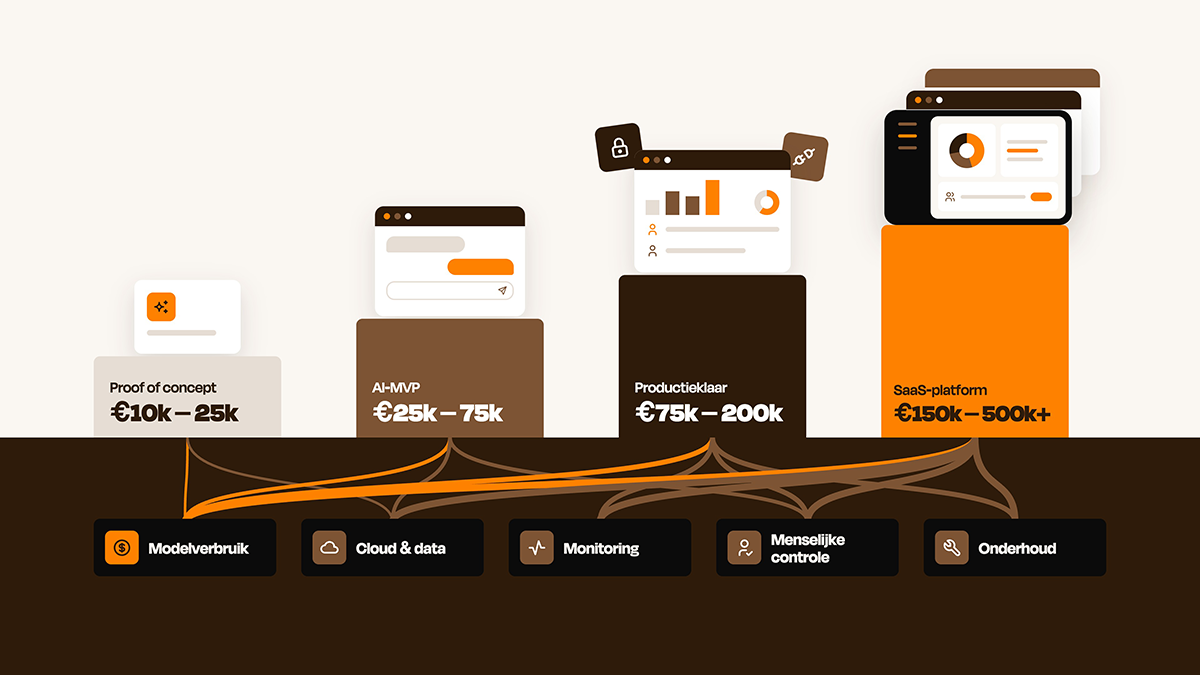
Software that isn't written efficiently by an AI consumes unnecessarily much computing power and API tokens. What starts as a cheap solution quickly turns into a monthly cloud bill that goes through the roof. For a professional application you should therefore look not only at the build costs, but also at the recurring costs of an AI application.
Vibe coding vs. AI-driven engineering
Is AI in software development a bad idea, then? Absolutely not. AI is the most powerful lever software engineers have been given in decades. The difference lies in who is in control.
| Aspect | Vibe Coding | AI-Driven Engineering |
|---|---|---|
| Direction | Prompts based on gut feeling (vibes) | System architecture & standards |
| Quality assurance | "It works on my screen" | Automated testing, CI/CD & code reviews |
| Security | Hoping afterwards that it's secure | Security-by-design & compliance check |
| End result | Fast prototype, high debt | Scalable, robust & future-proof |
With engineering AI is an accelerator of craftsmanship, not a replacement for it. An experienced engineer uses AI to automate repetitive work, but determines the architecture, data structures, security standards and test coverage themselves.
The Ninjible approach: 100% engineering, 100% success
At Ninjible we embrace AI to the full 100%, but exclusively according to proven software engineering principles. We don't believe in gambling with code or hoping a prompt will fix it.
By combining AI-driven speed with human oversight, tight architecture and continuous quality assurance, we deliver digital products and AI solutions faster than ever — with a success rate of 100%. No surprises afterwards, no hidden costs and no unmanageable technical debt.
Future-proof building with AI?
Choose AI solutions that are built to scale. Contact Ninjible for a no-obligation architecture scan of your AI plans.